
If you’re a low income American with a life-threatening, chronic or rare disease, then you need to know about The PAN Foundation! This organization can provide financial assistance to help with your out-of-pocket medical costs.
In this article, we will review what The PAN Foundation is, how it works, and how you can get the help that you need.
What is The PAN Foundation?
The PAN Foundation (also called The Patient Access Network Foundation) is a nonprofit organization that helps people who do not have adequate insurance cover their medical costs. They specialize in helping people who have chronic, rare, or life-threatening diagnoses.
This organization was founded back in 2004 to ensure that low income Americans could get the treatment they need. Since that time, the organization has helped more than one million people with their out-of-pocket prescription medication costs. Their total payouts exceed $4 billion!
What does The PAN Foundation pay for?
The PAN Foundation offers grants that can help people with certain diagnoses. Each grant works a little differently but there are typically four types of grants available through this organization.
Each of the grants are designed to help you for a 12-month period. The PAN Foundation has different funds available for different diagnoses, so the amount you will receive and the eligibility criteria will vary depending on what your specific diagnosis is.
Copay Grants
The Copay Grants can be used to pay for your out-of-pocket medication costs. This may include generics or bioequivalent medications.
When you use a Copay Grant from The PAN Foundation, you can choose which providers you see, which pharmacies you use, and which medications you want to cover. You still control your health care, you just get a little bit of financial help to afford it better.
Health Insurance Premium Grants
In some cases, you may be able to get a Health Insurance Premium Grant to help cover your health insurance premiums. These grants typically will not cover the full amount but will help you with a partial payment.
The PAN Foundation website says that health insurance premium grants are for patients who are being treated for specific disease states.
Transportation Grants
If you are already receiving a Copay or Premium Grant, then you can also apply for an additional Transportation Grant. This grant can help you pay for transportation to and from medical appointments and other activities that support your overall health.
A few examples of covered trips would include:
- Grocery shopping
- Pharmacies
- Social support
The Transportation Grant is $500 per year. The money is sent on a prepaid Visa debit card, which you will receive about 2-3 weeks after your application is approved.
In order to be eligible, you must be currently enrolled in a copay or premium fund from The Pan Foundation and have an income that is 500% or less of the Federal Poverty Level.
Second or Renewal Grants
If you are an active grant recipient, you can apply for a second grant or a renewal grant. These grants are only available to people who are already being assisted by The PAN Foundation.
Second grants are available when your PAN grant balance is $0 but you need more help with medication before the 12-month eligibility period ends.
Renewal grants are available when your initial 12-month eligibility period ends. If the fund is still open to applications, you can apply for another 12-month grant. Renewal grant opportunities open 30 days before the end of your current award period.
Who is eligible for help?
The PAN Foundation has separate funds for separate diagnoses. Each of these funds has different requirements for eligibility. Each fund also has its own independent status, so one fund may be open to applications while another is closed or on a waitlist status.
Generally, you will need to meet the following requirements in order to be eligible for a grant from The PAN Foundation:
- You must live and receive treatment in the United States (including territories).
- You must be diagnosed with the disease named in the fund.
- You must be receiving treatment for that condition OR have received treatment in the last 90 days OR be expected to begin treatment in the next 120 days.
- Your prescribed medication must be listed on the fund’s Covered Medications list.
- You must meet the income limits and insurance requirements listed on the fund’s page. These requirements may vary between funds.
The easiest way to find out if you are eligible is to review The PAN Foundation’s open disease funds. You need to see if there is a condition on the list that applies to you.
At the time of this writing, The PAN Foundation lists the following disease funds:
| CONDITION | AMOUNT |
| Acromegaly | $6,300 |
| Acute Myeloid Leukemia | $4,600 |
| Amyloidosis | $8,500 |
| Ankylosing Spondylitis | $5,200 |
| Asthma | $1,400 |
| Atopic Dermatitis | $3,700 |
| Basal Cell Carcinoma | $6,700 |
| Biliary Tract Cancer | $4,300 |
| Bipolar Disorder | $1,600 |
| Bladder Cancer | $2,500 |
| Breast Cancer | $5,700 |
| Chronic Lymphocytic Leukemia | $9,700 |
| Colorectal Cancer | $2,500 |
| Cushing’s Disease or Syndrome | $11,100 |
| Diabetic Foot Ulcers | $600 |
| Duchenne Muscular Dystrophy | $6,800 |
| Fabry Disease | $8,700 |
| Fabry Disease Premium | $4,500 |
| Gastrointestinal Stromal Tumors | $4,200 |
| Gaucher Disease | $10,300 |
| Glioblastoma Multiforme | $5,300 |
| Graft Vs Host Disease | $8,900 |
| Heart Failure | $1,200 |
| Hemolytic Uremic Syndrome | $7,000 |
| Hemophilia | $4,600 |
| Hemophilia Premium | $4,500 |
| Hepatitis C | $5,600 |
| HIV Treatment and Prevention | $3,600 |
| Hypercholesterolemia | $2,100 |
| Hyperkalemia | $1,600 |
| Immune Thrombocytopenic Purpura | $4,500 |
| Inflammatory Bowel Disease | $3,800 |
| Inherited Retinal Disease | $3,100 |
| Inherited Retinal Disease Premium | $4,500 |
| Liver Cancer | $6,500 |
| Lysosomal Acid Lipase Deficiency | $2,100 |
| Macular Diseases | $1,900 |
| Mantle Cell Lymphoma | $9,000 |
| Melanoma | $6,800 |
| Multiple Myeloma | $7,800 |
| Multiple Sclerosis | $6,000 |
| Myasthenia Gravis | $9,100 |
| Neuromyelitis Optica Spectrum Disorder | $4,800 |
| Neurotrophic Keratitis | $7,800 |
| Neutropenia | $2,200 |
| Non-Hodgkin’s Lymphoma | $6,200 |
| Non-Small Cell Lung Cancer | $5,200 |
| Ovarian Cancer | $3,700 |
| Pancreatic Cancer | $4,300 |
| Parkinson’s Disease | $3,300 |
| Paroxysmal Nocturnal Hemoglobinuria | $6,800 |
| Pemphigus Vulgaris | $6,600 |
| Philadelphia Chromosome Negative Myeloproliferative Neoplasms | $10,500 |
| Plaque Psoriasis | $4,600 |
| Pompe Disease | $6,800 |
| Postmenopausal Osteoporosis | $600 |
| Prostate Cancer | $7,000 |
| Psoriatic Arthritis | $3,100 |
| Pulmonary Hypertension | $5,900 |
| Renal Cell Carcinoma | $6,500 |
| Retinal Vein Occlusion | $2,000 |
| Rett Syndrome | $5,500 |
| Rheumatoid Arthritis | $4,700 |
| Schizophrenia | $3,200 |
| Short Bowel Syndrome | $20,100 |
| Short Bowel Syndrome Premium | $4,500 |
| Sickle Cell Disease | $3,700 |
| Small Cell Lung Cancer | $5,200 |
| Spinal Muscular Atrophy | $5,800 |
| Systemic Lupus Erythematosus | $6,300 |
| Type 2 Diabetes | $3,100 |
| Uveitis | $900 |
| Venous Leg Ulcers | $800 |
| Von Willebrand Disease | $2,600 |
| Waldenstrom Macroglobulinemia | $7,000 |
Some funds are open, others are closed, and some are accepting applications on the waitlist. Even if the fund is closed, The PAN Foundation offers a FundFinder that can help you find financial support from other organizations.
How do I apply?
Applying is actually very easy!
Find Your Fund
First, you need to visit The PAN Foundation disease fund list and find the condition that applies to you. Click on the name of the condition in the alphabetized list.
If you prefer, you can click the “Medications” tab and sort by medication instead. I prefer to sort by condition because the medications list is longer and more confusing.
Check the Status
All of the funds from The PAN Foundation have three potential statuses:
- Open, which means they are accepting applications
- Waitlist, which means that the program is currently only available to people who signed up for the wait list
- Closed, which means that the program is currently full and they are not accepting any new applications
Closed
A closed fund is not accepting new applications because it’s already operating at capacity. If the fund is closed, you will be given two choices. You can sign up for the wait list and use the FundFinder to find other help.
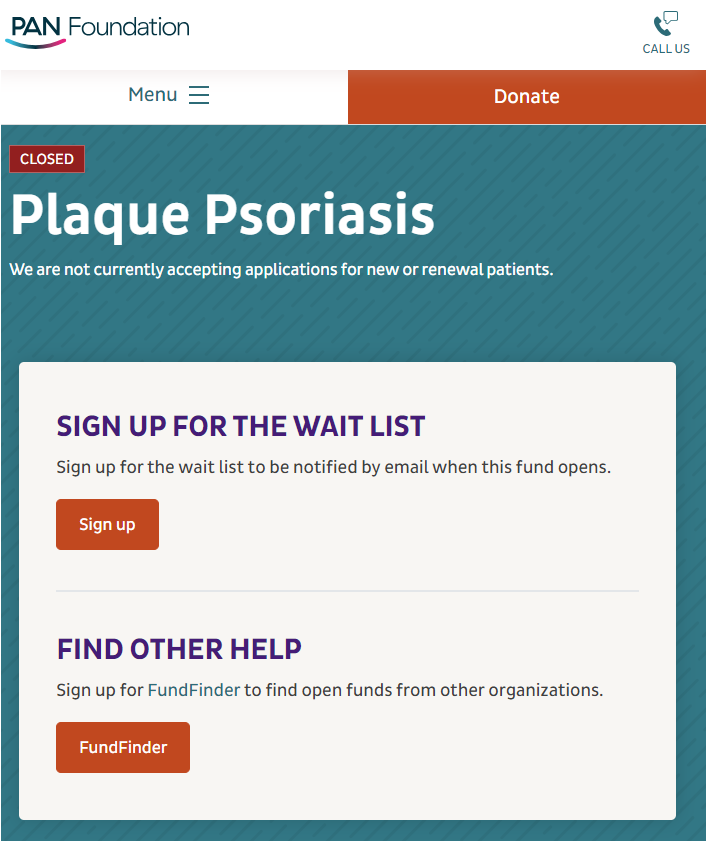
If you are interested in a closed fund, you should join the wait list. The people who sign up for the wait list are notified two days before the fund opens to the public again.
In order to sign up for the wait list, you will need to provide some basic information about your diagnosis, your contact information, and your provider or pharmacy. You will also need to use an email that you check often. After all, the waitlist notification will be sent over email and you don’t want to miss it!
After you sign up for the wait list, use the FundFinder tool to see if there are any other programs that may be able to assist you in the meantime.
Waitlist
If the fund is on a Waitlist status, it means that it is only available to people who have already signed up for the wait list. Check back in two days and you should be able to apply!
In the meantime, make sure to join the wait list for any funds that you are interested in so that you can also get early access when they open.
Open Funds
If the fund that you are eligible for is currently accepting applications, you’ll see big box that says “APPLY TODAY.” This is great news – it means you’re ready to move on to Step 3!
Step 3: Complete the Application
You can apply for an Open Fund directly on the page. You just start by answering the first question, which is to select whether you are a patient, provider or pharmacy. Click the “next” button to enter the pre-screening questionnaire. This tool will help you determine if you are eligible.
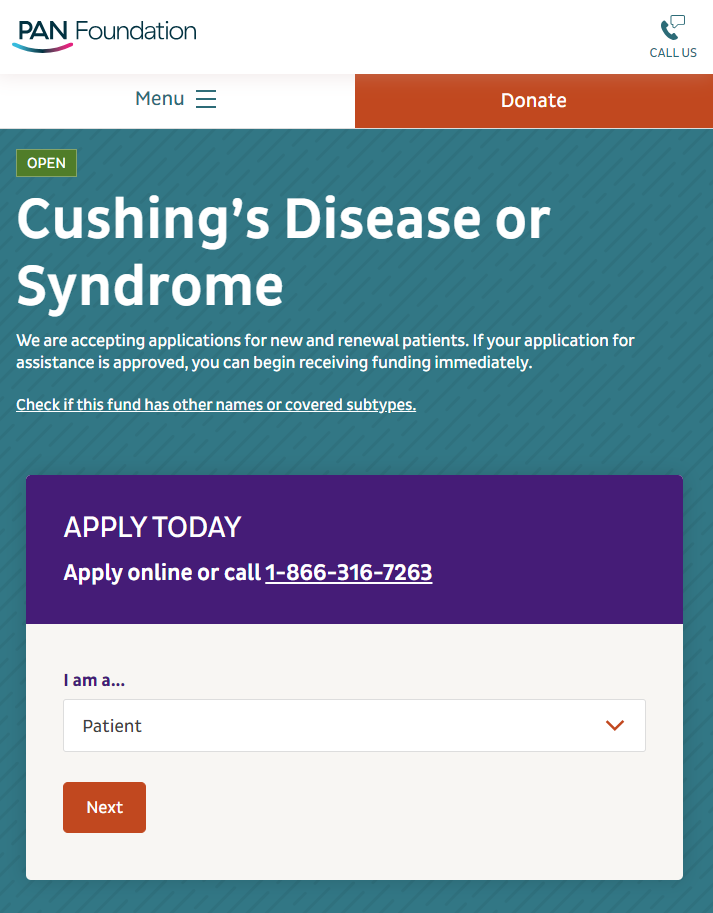
The pre-screening questionnaire is actually very simple. It will ask you which medication you are currently taking, whether or not you live in the United States, if you have insurance, and some basic questions about your household size and income.
If the questionnaire indicates that you are eligible for the program, you will be able to apply.
Things to Remember
You can choose to call The PAN Foundation at 1-866-316-7263 for assistance if you would rather apply over the phone. Their offices are open on weekdays between 9am and 5:30pm ET.
When you apply, it’s important to have your medication list, provider’s contact information, health insurance information, and income data available. You will need it to complete the application.
You may be required to upload documentation to verify your health insurance costs or household income. Don’t forget to submit that documentation as soon as possible!
Summary
The PAN Foundation offers grants of up to $20,000 to patients with specific chronic, rare or life-threatening conditions. The funds are intended to help you pay for medications, insurance premiums or transportation to support your health. Use the guidance in this article to find out which conditions they cover and how you can apply!

I have CKD – Glomulonephritist (I think I spelled it correctly) stage 3 B. Would this be one of the conditions or diseases for one of these grants? I had to cancel my last two kidney doctor appointments due to travel. I don’t have a vehicle and the hospitals or specialists that I was supposed to go to are 3 hrs drive away. I’m not able to work (stay sick) but don’t qualify for disability. Any help would be wonderful. Thank you so much for your time.
Hi Bill. Even if they can’t, The PAN Foundation offers a FundFinder that can help you find financial support from other organizations.
I’m a Senior (68) with 9 med. conditions including Type 2 Diabetes, I MAKE blood clots – Protein C & S deficiency; PTSD; BP; Chol; a brain congenital problem: Congenitally malformed blood vessel in the cerebral part of my brain causing FROM BIRTH dizziness, balance and BP issues, nobody knew why I can pass out or spikes in BP or balance issues, when my Neurologist Dr. Hennesey discovered this on a MRI of my head/neck, he said “now we know why you’ve had all of these issues and you will use either a cane or rollator for balance from now on and I’m ordering you a Perm. Handicapped tag.” Didn’t find this out until I was 52. With that & the other conditions I was put on Judge ordered Soc. Sec. Disability from 11-1-09 until 12-1-21. They officially retired me with a letter of retirement at age 66.