
Big changes are coming to Medicaid that could force some adults to work, go to school, volunteer or participate in “community engagement” at least 80 hours per month in order to keep their benefits. These rules are expected to start rolling out no later than January 1, 2027 – and will go into effect much earlier in some states.
We have reviewed the entire 400+ page rule that CMS issued to help you understand what is happening, why it’s happening, and what it might mean for you. Let’s break it down.
Why This is Happening
According to the federal government’s new intirim final rule, “Medicaid should be a short-term hand up, not a lifetime handout.” Their goal is to get more people engaged in the workforce because they claim it’s good for you and good for the country.
Here’s what the government is saying about this:
- Employment is good for you. It leads to more stable income, better housing, better access to food, better overall health outcomes, greater independence and self-sufficiency. They claim Under varying conditions, including job availability and implementation quality, the policy could reduce poverty by 1.6 to 2.9 million people.
- Other programs have work rules. The rule repeatedly points out that other means-tested benefit programs like SNAP and TANF already have work requirements. The administration presents this change as bringing Medicaid into alignment with other welfare programs that encourage employment and community participation.
- The work rules allow them to focus on the “most vulnerable” groups. The rule says that Medicaid enrollment exceed 82 million people in Fiscal Year 2025. That’s about 24% of the population, or almost 1 in every 4 Americans. They say that about 20 million of those are adults from the ACA expansion, and that the government spends about $200 billion on that population. They’re saying that implementing these work rule changes will help focus resources on those who need them most.
The idea of tying work rules to Medicaid is not entirely new. This is something that was brought up during President Trump’s first term, too. At that time, the government approved 13 special Medicaid pilot programs to test work rules. Lawsuits stopped many of those programs from moving forward, and only Arkansas and Georgia actually launched work requirement programs. Georgia’s is the only one that continued.
The concept of work rules got a boost when Congress passed a law requiring that states enact these requirements nationwide. Here’s the timeline for what happened and is happening:
- July 4, 2025: Congress passed a law requiring work rules as part of the Medicaid program. This bill was known as the One Big Beautiful Bill Act and is also known as the Working Families Tax Cut.
- June 1, 2026: The Centers for Medicare and Medicaid Services released a new interim final rule describing how these new work requirements should be implemented.
- January 1, 2027: This is the deadline for states to implement these changes, although some states are implementing them much sooner.
Now let’s look at what these new rules mean for you.
Who is Affected?
The good news is that not everyone who receives Medicaid will need to work, volunteer, or participate in other qualifying activities. The law only applies to certain adults.
You may have to work to keep your Medicaid if:
- You are between the ages of 19 and 64.
- You are not eligible for an exemption due to pregnancy, disability or other reasons.
Medicaid is supposed to determine whether you qualify for an exemption before evaluating whether you met the community engagement requirement. If you qualify for one of the exemptions below, the work requirement generally does not apply to you.
You may be exempt if:
- You are a member of a federally recognized tribe; OR
- You qualify as an American Indian or Alaska Native under Indian Health Service Rules; OR
- You are an Urban Indian; OR
- You are a California Indian covered by the Indian Health Care Improvement Act
Many states already collect this information for Medicaid purposes so the exemption should be both automatic. If Medicaid cannot verify your status, you may need to provide them documentation from a tribe, the Indian Health Service (IHS) or another approved source.
This is a permanent exemption. The rule says that states “will not be required to (and may not) reverify someone’s status.” Once Medicaid verifies that you qualify for this exemption, the state generally cannot keep making you prove it over and over again.
You may be exempt if:
- You are a veteran with a 100% disability rating from the VA (including a TDIU rating)
This exemption applies whether the VA considers your disability rating permanent or temporary. You may also qualify if you receive TDIU, which allows veterans below 100% to be compensated at the 100% rate if they are unable to engage in substantially gainful employment.
Medicaid will likely be able to verify your disability rating automatically through government records. If for any reason they cannot, you may need to provide a benefits verification letter.
This is an ongoing exemption. If you have a permanent and total (P&T) rating, the state generally cannot require ongoing verification. If it is a temporary 100% rating, you may need to recertify at least once every 12 months. If you ever lose your 100% disability rating or TDIU, the exemption would also end.
You may be exempt if:
- You were in foster care when you aged out of the system; AND
- You were enrolled in Medicaid while in foster care; AND
- You are under age 26.
This exemption applies even if you moved to a different state.
States will often be able to verify this through records. However, if Medicaid does not know your foster care history, you may need to provide documentation showing that you were in foster care and enrolled in Medicaid during that time.
g as your household receives sNAP benefits and you remain subjected to at least one of the SNAP work requirements.
This is a temporary exemption until you turn 26. However, you should not have to re-verify your status once it is confirmed.
You may be exempt if you have a physical, mental, or behavioral health condition that significantly impairs your ability to work, volunteer, or otherwise meet the work requirements.
This exemption may apply to you if:
- You are blind or disabled under Social Security rules; OR
- You have a substance use disorder with less than 5 years of stable recovery; OR
- You have a disabling mental health condition; OR
- You have a physical, intellectual, or developmental disability that significantly limits your ability to perform one or more Activities of Daily Living; OR
- You have a serious or complex medical condition, which is defined as “a medical condition that is life threatening, seriously disabling without necessarily being life threatening, causing significant pain or discomfort that can cause serious interruptions to life activities, requiring a major time or effort commitment from caregivers for a substantial period of time, requiring frequent monitoring, associated with severe consequences or negative consequences for someone else, affecting multiple organ systems, requiring management to tight physiological parameters, requiring coordination of multiple specialties, requiring treatment that carries a risk of serious complications, or requiring adjustment in non-medical environments.”
It is important to note that the rules for physical, intellectual, and developmental disabilities reference ADLs specifically. Activities of Daily Living, or ADLs, include basic personal care tasks like bathing or showering, dressing, getting in and out of bed or a chair, walking, using the toilet, and eating. According to the rule, “An individual with such a disability that does not significantly impair their ability to perform one or more ADLs would not qualify for this exclusion.”
For serious or complex medical conditions, CMS is looking at conditions that significantly impair your ability to meet the requirement. Examples may include conditions like cancer, end-stage renal disease, sickle cell disease, COPD, HIV/AIDS, cognitive impairment, heart disease, ALS, Parkinson’s disease, Huntington’s disease, cystic fibrosis, multiple sclerosis, muscular dystrophy, hemophilia, and other serious conditions.
However, simply having one of these diagnoses does not automatically mean you qualify. The condition must significantly impair your ability to work, volunteer, attend school or training, or otherwise meet the community engagement requirement.
The rules state, “In addition, we believe that if individuals with a serious or complex medical condition do not have significantly impaired ability to comply with the community engagement requirement, participating in community engagement activities, such as employment, could potentially help them escape isolation and dependency, build confidence, achieve self-sufficiency and prosperity, and improve health.”
CMS also said it would not typically expect conditions like asthma, hypertension, anemia, generalized pain, pre-diabetes, Type 1 or Type 2 diabetes, obesity, psoriasis, headaches, or ADHD to significantly impair someone’s ability to meet the requirement. However, each person’s situation may depend on the severity of their condition.
States are supposed to maintain lists of health care codes that may qualify someone as medically frail. These lists must be auditable, justifiable, and consistent with the federal definitions. States are also expected to update those lists over time as medical treatments and implementation experience change.
However, states cannot automatically deny your request just because your diagnosis is not on their standard list of qualifying conditions. They must provide a way for you to submit additional information showing that your condition significantly impairs your ability to meet the requirement.
Medicaid may identify some qualifying conditions through existing records. For example, data matching may show if you are blind or disabled under Social Security rules.If Medicaid cannot verify your condition automatically, you may need to provide medical documentation.If your condition is not on the state’s list of qualifying conditions, you may need to follow a specific process to request consideration for the medically frail exemption.
If you need to provide documentaiton, it doesn’t necessarily mean a doctor’s note. States may accept information from other qualified medical and behavioral health professionals, including nurse practitioners, physician assistants, psychologists, counselors, therapists, clinical social workers, and other practitioners recognized under state law.
This is an ongoing exemption that generally continues as long as your condition significantly impairs your ability to meet the community engagement requirement. However, states are expected to reverify medical frailty at least once every 12 months. In many cases, this can be done automatically using Medicaid claims, Social Security disability records, or other available data sources. If the state cannot verify your status automatically, you may be asked to provide documentation.
You may be exempt if:
- You are a parent or legal guardian of a disabled person and you provide care to that person; OR
- You are a caretaker relative who lives with a disabled relative and is primarily responsible for their care; OR
- You are a family caregiver who provides regular care and assistance to a disabled individual.
More than one caregiver in the same household may qualify if each person meets the requirements.
If the disabled person is a relative or someone that you live with, there are no minimum hourly caregiving requirements. However, you must provide assistance on a regular basis and the assistance cannot be merely incidental.
You may still be able to qualify if you provide significant care to a friend, neighbor, or another person that you do not live with. However, if you are not related to them and do not live together, you will need to provide at least 80 hours a month of care in order to qualify.
The disabled person does not need to receive Social Security Disability (SSDI), Supplemental Security Income (SSI), or Medicaid disability benefits to qualify. Medicaid uses a broader disability standard based on the Americans with Disabilities Act (ADA). In fact, the rules say that states generally cannot require you to provide the name or identifying information of the person you are caring for if you do not have that person’s permission to share it. Instead, they must allow other information that shows the person meets the disability definition.
There is no age limit for the person receiving care. This exemption may apply if you care for a disabled child, a disabled adult, or an older adult with a qualifying disability.
Medicaid may be able to verify some caregiving relationships through existing records. If Medicaid cannot verify your situation automatically, you may need to provide documentation showing the individual’s disability and your caregiving role.
This is an ongoing exemption that generally continues as long as the individual remains disabled and you continue providing qualifying care.
You may be exempt if:
- You are a parent of a child age 13 or younger who depends on you for care; OR
- You are the child’s legal guardian; OR
- You are a caretaker relative (such as a grandparent, aunt or uncle, sibling, cousin or other qualifying relative) who lives with the child and is primarily responsible for the child’s care; OR
- You are a family caregiver who has a significant caregiving relationship with the child.
More than one person in the household may qualify for this exemption if each person meets the requirements. For example, both parents my qualify, or a parent and grandparent may qualify if they both actively care for the child.
Medicaid may be able to verify your relationship through existing records. However, if Medicaid cannot verify your caregiving role, you may need to provide documentation showing your relationship to the child or your caregiving responsibilities.
This is a temporary exemption that only lnerally continues as long as the individual remains disabled and you continue providing qualifying care.
You may be exempt if:
- You receive TANF; AND
- You are complying with your state’s TANF’s work requirements
The federal government is allowing each state to decide what counts as compliance with TANF work requirements. Because TANF programs vary from state to state, Medicaid will generally rely on information from the agency that administers TANF rather than asking you to prove compliance yourself.
You don’t need to do anything. TANF and Medicaid are expected to share that information automatically.
This exemption continues as long as you remain compliant with the TANF work requirements. If you stop meeting those requirements or stop receiving TANF, this exemption may end.mption. If you have a permanent and total (P&T) rating, the state generally cannot require ongoing verification. If it is a temporary 100% rating, you may need to recertify periodically. If you ever lose your 100% disability rating or TDIU, the exemption would also end.
You may be exempt if:
- You are currently pregnant; OR
- You are receiving Medicaid postpartum coverage after a pregnancy has ended.
This exemption applies regardless of whether you are working, looking for work, attending school, volunteering, or participating in other community engagement activities.
Medicaid will usually be able to verify your pregnancy or postpartum status through existing records. In some cases, you may need to provide documentation from a medical provider. The state must accept an attestation of pregnancy unless it has conflicting information.
This is a temporary exemption that lasts during your pregnancy and during your postpartum coverage period. In most states, that will be 12 months after the end of the pregnancy.
You may be exempt if:
- You receive SNAP; AND
- You are subject to at least one SNAP work requirement
This is one of the strangest exemptions in the rule. Unlike TANF, you do not have to prove that you are complying with SNAP work requirements. You only need to be subject to either the general work or time-limit work requirements.
You do not need to do anything to get this exemption. Medicaid is expected to work with the SNAP agency to identify those who qualify.
This exemption generally continues as long as your household receives sNAP benefits and you remain subjected to at least one of the SNAP work requirements.
You may be exempt if:
- You are currently incarcerated in a public institution like a prison, jail, detention facility or other penal institution; OR
- You were incarcerated at some point during the three months before the month being reviewed for the community engagement requirement.
States should be able to verify your eligibility for this exemption automatically.
This is a temporary exemption. If you are currently incarcerated, the exemption generally continues while you remain incarcerated. After you are released, you may continue to qualify for a temporary exclusion for up to three months following your incarceration. For example, if you were released from jail in March, Medicaid may still treat you as exempt during the following months because you were incarcerated within the previous three months.
The purpose of this rule is to give people time to transition back into the community before they are expected to meet the Medicaid community engagement requirement.
You may be exempt if:
- You are participating in an drug addiction treatment program; OR
- You are participating in an alcohol treatment or rehabilitation program
The program must be operated by a either a nonprofit or a qualifying public community health center. The purpose must be to provide treatment that leads to recovery.
It appears that the federal government did not establish a minimum number of days, hours or appointments that you must attendt o qualify. Instead, states are expected to set their own standards for what counts as participation.
Medicaid may be able to verify your participation through data sharing, but if they can’t verify it automatically then you may need to provide documentation from the program.
This is a temporary exemption that only applies while you are participating in the program. Once you stop, the exemption may end. However, there is a separate exemption for people with substance use disorders listed under the “medically frail” category.
Not every state has to offer this hardship exception. States can choose whether to include this in their Medicaid programs
You may qualify for a hardship exception if:
- You receive inpatient hospital services; OR
- You stay in a nursing facility; OR
- You receive services in an Intermediate Care Facility for Individuals with Intellectual Disabilities (ICF/IID); OR
- You receive inpatient psychiatric hospital services; OR
- You receive other services that your state considers to be of similar medical severity such as some outpatient or home/community-based alternatives.
The exception may also apply to certain outpatient services related to these types of institutional care.
You generally need to request this hardship exception from the state. It is temporary, and only lasts during the months in which you qualify.
Please note that if you qualify as medically frail, Medicaid generally should not need to evaluate whether you also qualify for a hospitalization-related hardship exception.
Not every state has to offer this hardship exception. States can choose whether to include this in their Medicaid programs
You may qualify for a hardship exception if:
- You live in an area where a federal emergency or disaster has been declared; OR
- You live in an area with an unusually high employment rate of 8% or 1.5 times the national unemployment rate.
This exemption should be applied automatically if your state chooses to offer it and you qualify. The exception generally ends when the emergency, disaster or qualifying unemployment conditions no longer exist.
Not every state has to offer this hardship exception. States can choose whether to include this in their Medicaid programs
You may qualify for a hardship exception if:
- You need to travel outside your community for extended periods to receive treatment for a serious or complex medical condition; OR
- Your dependent needs to travel outside your community for an extended period to receive treatment for a serious or complex medical condition.
To get this exception, you generally must request this hardship exception from the state. You may need to provide documentation showing the medical condition, the need for treatment, and an explanation of why that treatment isn’t available locally.
Interestingly, CMS says you may qualify for this even if you don’t travel with your child to their treatment. You might still qualify if you can show the child’s treatment caused you to miss work or community engagement activities because you were coordinating care, handling logistics, communicating with doctors, etc.
This is a temporary exception that only continues when the necessary travel and treatment continue.
If at any point you are no longer eligible for an exemption, the state is supposed to notify you and give you credit for any time that you were exempt. For example, if your child turns 14 in June, the state doesn’t immediately terminate your coverage. They have to count the months that you were exempt as if you demonstrated community engagement.
If you were denied an exemption, you also have the right to appeal. You can request a fair hearing if you think you qualify for an exemption and were denied.
What Counts as Work?
In order to meet the new work requirements, an applicable individual has to participate in at least one of the following:
- You must work, volunteer or participate in a work program at least 80 hours per month; OR
- You must be enrolled in an educational program at least half-time; OR
- You must engage in some combination of the aforementioned activities that equates to 80 hours; OR
- You must have a monthly income that is at least 80 hours times the federal minimum wage (currently $580/month)
Let’s talk about what counts under each category.
Work may include:
- Regular paid employment from any job where you earn money. This can include full-time, part-time, hourly, salaried jobs, or temporary jobs.
- Self-employment from running your own business, freelancing, or independent contractor work like Uber, DoorDash, Etsy, consulting, etc.
- Work paid with goods or services instead of money, which is sometimes called in-kind work. This is when you work in exchange for housing, meals, utilities or other non-cash benefits. For example, if you manage an apartment complex in exchnage for free or reduced rent, then the hours spent managing the apartment may count.
- Unpaid internships that provide job or work experience, like an unpaid bookkeeping position at a private company.
- Unpaid job training or trial work that allows you to gain skills or experience before being hired.
- Certain unpaid caregiving roles such as family caregiving that does not already qualify for the caregiver excemption (which we’ll discuss below).
Some work activities that would likely count include:
- Working 20 hours a week at Walmart
- Driving for Uber or DoorDash
- Running an Etsy shop
- Freelance writing or graphic design
- Managing an apartment building for free rent
- Unpaid internship at a law office
- Unpaid trial work at an accounting firm before getting hired
The state will require documentation or verification of the hours worked. Simply claiming the hours may not be enough; beneficiaries will likely need to provide records showing they completed the work.
Community service must be unpaid and completed through a structured program that is sponsored by a nonprofit or public organization. There must be someone there who can verify your community service hours and attest that the work you do directly benefits the community instead of one specific person.
Some examples of community service that would likely count include:
- Volunteering at a food bank
- Tutoring or mentoring youth through a nonprofit program
- Delivering meals to seniors through an organized program like Meals on Wheels
- Cleaning parks, trails or public spaces with a community organization
- Helping at a Church-run community outreach program
- Court-ordered community service was explicitly listed as counting toward this requirement
However, providing service to one individual outside of an organized program does not count so you can’t count hours spent helping a friend move, or mowing a neighbor’s lawn, or volunteering for a political campaign.
A work program is not the same as looking for a job on your own. To count as a work program, it must be an official government or job-training program that is approved and operated by a government agency or qualifying workforce organization.
Programs that would count include:
- Workforce Innovation and Opportunity Act (WIOA) programs that are offered through local workforce centers. These may include skills training, certifications, apprenticeships, and career counseling.
- SNAP Employment and Training programs that are offered through the SNAP program. These can include classes, training, work experiences, and employment services.
- State employment and training programs that are operated or supervised by the government and meet state-approved standards.
- Veterans employment programs that are operated by the Department of Labor or the VA
- Workforce partnership programs may also count if they are recognized under federal law.
It is important to note that job search activities must account for less than half of the required hours, even if the program is covered by one of the above categories. The new rule specifically states that job search cannot be the primary activity, so there must be a mix of skills training and other services offered.
It is also important to note that it doesn’t count if you’re doing it on your own outside of an organized program. You cannot count hours that you spend looking for jobs at home, browsing Indeed, or sending resumes without participating in a qualifying work program.
You can meet the Medicaid community engagement requirement if you are enrolled at least half-time in a qualifying educational program.
Programs that count may include:
- College or university programs
- Community college programs
- Trade schools
- Career and technical education programs
- Vocational training programs
- High school (if you’re 19+ and still enrolled; those 18 and under do not have to meet the work requirements)
- GED or other state-approved high school equivalency programs
If you are enrolled in a qualifying education program at least half-time, then that enrollment covers you for the work requirements even during summer break, winter break, spring break and other recess periods as long as you are returning for the next term. This means you don’t have to scramble to find qualifying work or volunteer opportunities when school is not in session.
Please note that studying for the GED on your own or participating in self-paced online learning that is not part of a state approved program does not count. You also can’t just take random online courses, either. Your educational participation must be part of a recognized educational program and you must be enrolled at leaset half-time.
Alternatively, if you meet the monthly income requirements, you may automatically meet the requirement even if you don’t document 80 hours of work.
The final rule says that states must use the federal minimum wage to determine if someone is meeting the minimum requirements. If your monthly income is at least 80 times the federal minimum wage, you satisfy the requirements.
The current minimum wage in 2026 is $7.25 per hour. That means that you need to earn $7.25 an hour x 80 hours = $580 per month.
The good news is that many states and jobs pay well above that $7.25 minimum wage, so it may require far less hours to meet the requirement. For example, in Washington State where the minimum wage is $17, a worker could satisfy this requirement in just over 34 hours instead of 80.
For seasonal workers, the state can look at the average income over the previous six months to see if you satisfy the requirement.
If you don’t meet the requirements through either work, service, work programs or education alone, you can combine those activities to reach the 80 hours per month. This is basically the mix and match option.
For work, community service, and work programs, you will need to track the number of hours you partiicpate in each program. It’s pretty straightforward.
If you earn more than the federal minimum wage, there is also a combination rule you need to be aware of. If the state is able to verify the numbers of hours you worked, then they can count those exact hours. However, if the state can verify your income but does not have information about the number of hours you worked, the state can choose to estimate your hours by dividing your monthly income by the federal minimum wage. For example, if you are self-employed and earned $400 during the month, but the state cannot verify how many hours you worked, it could divide $400 by the federal minimum wage of $7.25 per hour and credit you with about 55 hours of work for that month.
For education, it’s a little more complicated. As long as you are enrolled at least half-time, you do not need to worry about combining with other methods. However, if you are less than half-time, the new rules say that you can count your hours as follows:
- Credit Hours: If your school uses credit hours, the government assumes that each credit hour requires 2 hours of homework or personal study. Thus, you can count 3 hours per week for each credit hour you are enrolled in.
- No Credit Hours: If your school does not use credit hours, the new rule only allows you to count the actual time you are attending school.
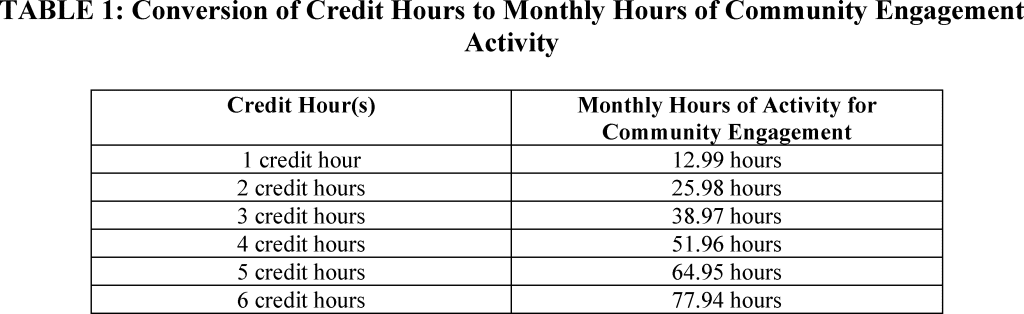
For example, CMS gives the example of a student who is enrolled in four college credits. This counts as 52 hours per month. The student works another 30 hours per month, for a total of 82 hours. Since they are over the 80 hour limit, they met the requirements.
States will ultimately be responsible for implementing these requirements, so exact procedures may vary. However, the information in this report is based on our review of the federal rule published in the Federal Register.
What Happens if You Don’t Meet the Requirement?
If the state thinks you did not meet the community engagement requirement, your coverage generally will not end immediately.
Instead, the state must send you a Notice of Noncompliance. This notice should explain why the state believes you did not meet the requirement and how you can show that you qualified through work, school, volunteering, an exemption, an exception, or another qualifying activity.
The state must give you 30 days to respond after you receive the notice. Federal rules generally assume that you receive the notice 5 days after it is mailed unless you can show otherwise. Your Medicaid coverage is supposed to continue during this response period.
You may use this time to provide information showing that you:
- Met the community engagement requirement;
- Qualified for an exemption;
- Qualified for an exception; or
- Remain eligible for Medicaid on another basis.
If the state ultimately determines that you are not eligible, it must provide written notice and appeal rights before terminating your coverage.
Even better, federal rules prohibit states from imposing lockout periods. If you lose Medicaid because of the community engagement requirement, you do not have to wait a certain amount of time before applying again. You may reapply immediately if you believe you qualify.
If you lose Medicaid because you did not meet the community engagement requirement, you may not qualify for Marketplace premium tax credits that help lower the cost of private health insurance. Federal rules generally treat you as though you remained eligible for Medicaid for purposes of those subsidies.
When does this begin?
States have to implement these changes by January 1, 2027 but some states are choosing to start earlier. Nebraska has already begun their work rules, and Montana is scheduled to begin soon. Other states may also launch before January.
If a state can’t do it by January, they may be able to get a Good Faith Exemption to delay implementation in their state. Once it starts your state, you can expect the new requirements to take effect at your next renewal cycle.
Please remember that your state must start reaching out months before the changes begin. The federal rules say those notices have to be sent to everyone because a person’s status can change over time. These messages may arrive by mail or other methods. Please remember that receiving a community engagement notice does not necessarily mean you must meet the requirement. Some people who receive notices may still qualify for exemptions or exclusions.
What Else to Know
The rule that was published outlines some key details on how this process will work.
- States can choose how strict to be. If you have to participate in community engagement, they can decide whether to require 1, 2, or 3 months of compliance before your application or renewal.
- They can check compliance more often. The state has to process recertifications every six months but they can choose to check compliance more frequently if they wish.
- States have to check before asking you for paperwork. States are required to check available records and electronic databases before asking you for paperwork. If they cannot verify your eligibility through existing records, they may ask for documentation. If documentation is not reasonably available, they must provide a way for you to submit other information to support your claim.
- This rule may change over time. The law required HHS to issue an Interim Final Rule (IFR) by June 1, 2026, and specifically exempted the agency from the normal notice-and-comment requirements under the Administrative Procedure Act. They are still accepting comments and may modify it in the future.
Relief Recap
This is a major change to Medicaid, but it is important to remember that not everyone will be affected. The most important thing you can do is make sure Medicaid has your current contact information and pay close attention to any notices you receive. Federal rules require states to provide notice, opportunities to respond, and appeal rights before coverage can be terminated.
As states begin implementing these changes, procedures may vary somewhat from state to state. We will continue monitoring new guidance and state policies and will update this article as more information becomes available.
If you know someone who relies on Medicaid, please share this information with them so they can understand their options and prepare for any upcoming changes.
